

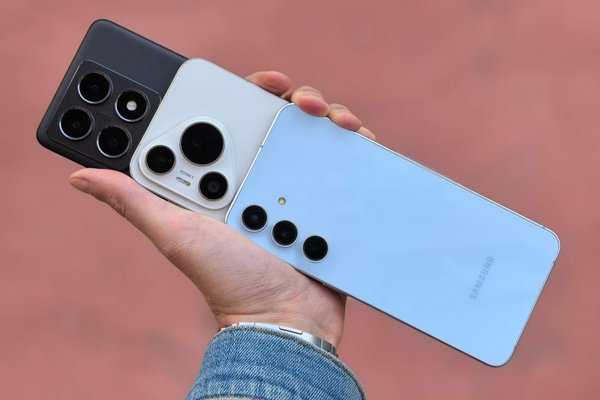
Compact phones are no longer underpowered alternatives. The OnePlus 13s and Vivo X200 FE both pack flagship hardware into bodies that are easier to hold, carry and use one-handed. That makes the oneplus 13s vs vivo x200 fe decision unusually interesting: the two phones are almost identical in size and weight, yet they prioritise different things. OnePlus leans towards raw speed and streamlined software, while Vivo puts more emphasis on cameras, battery capacity and durability.
Design and everyday comfort
Both models fit the modern definition of a compact flagship rather than a genuinely tiny phone. The OnePlus 13s measures about 150.8mm tall, 71.7mm wide and 8.2mm thick, with a weight of 185g. The Vivo X200 FE is similarly sized at 150.83mm by 71.76mm, but it is slightly thinner at 7.99mm and weighs 186g.
There is little between them in the hand, and both are easier to manage than large Ultra-style phones. OnePlus adds a customisable Plus Key for shortcuts. The bigger practical difference is protection: the Vivo carries IP68 and IP69 ratings, whereas the OnePlus 13s has a more limited IP65 rating. Vivo is the safer choice for buyers who prioritise water resistance.
Display quality
The OnePlus 13s uses a 6.32-inch LTPO AMOLED display with a 2640 x 1216 resolution, 460ppi density and a dynamic 1-120Hz refresh rate. The Vivo X200 FE has a 6.31-inch AMOLED panel with the same resolution and density, plus a 120Hz refresh rate.
Both screens are sharp, smooth and suited to reading, gaming and video. OnePlus has LTPO technology, which can reduce the refresh rate when the screen is static and may improve efficiency. Vivo counters with very high advertised peak brightness and 2160Hz PWM dimming. In everyday use, either display should feel flagship-level, so this part of the compact flagship comparison is close.
Performance and software
Performance is where the OnePlus 13s establishes its clearest lead. It runs on Qualcomm’s Snapdragon 8 Elite platform, paired with 12GB of LPDDR5X RAM and either 256GB or 512GB of UFS 4.0 storage. The Vivo X200 FE uses the MediaTek Dimensity 9300+, with 12GB or 16GB of LPDDR5X RAM and UFS 3.1 storage.
The Dimensity chip remains powerful enough for demanding apps, photography and high-end gaming. However, the Snapdragon 8 Elite is the newer, faster platform, particularly for sustained gaming and processor-heavy work. OnePlus also includes a large vapour chamber cooling system, reinforcing its performance-first positioning.
The OnePlus 13s launched with OxygenOS 15 based on Android 15, while the Vivo X200 FE uses Funtouch OS 15 based on Android 15. OxygenOS generally feels cleaner and more direct, although both interfaces include AI tools and extensive customisation. A OnePlus 13s review will naturally focus on speed; a Vivo X200 FE review is more likely to highlight its broader hardware package.
Cameras: versatility versus simplicity
The Vivo X200 FE is the stronger camera phone on paper. Its rear system combines a 50MP main camera with optical image stabilisation, a 50MP periscope telephoto camera with OIS and 3x optical zoom, plus an 8MP ultra-wide camera. It also has a 50MP autofocus front camera. ZEISS portrait modes and multiple focal lengths make it appealing for travel, portraits and distant subjects.
The OnePlus 13s has a simpler dual-camera arrangement: a 50MP stabilised main camera and a 50MP telephoto camera with 2x optical zoom. Its 32MP autofocus selfie camera is capable, and OnePlus supports 4K Dolby Vision video, burst capture and AI editing. However, there is no ultra-wide camera, and the shorter telephoto reach limits flexibility.
For quick everyday photos, the OnePlus should perform well. For buyers who want one compact device to cover landscapes, portraits and zoom shots, Vivo has the more complete system and wins the camera round.
Battery life and charging
Vivo fits an impressive 6500mAh battery into the X200 FE and supports 90W wired charging. The OnePlus 13s has a smaller but still substantial 5850mAh battery with 80W SUPERVOOC charging. Neither model supports wireless charging.
Actual endurance depends on display settings, mobile signal and workload, but the Vivo’s 650mAh capacity advantage gives it the stronger starting point. The OnePlus may recover some ground through its efficient Snapdragon chip and LTPO display. Even so, heavy users and travellers will probably appreciate the Vivo’s extra battery headroom.
Price and value for 2026 buyers
In India, the OnePlus 13s was listed from ₹54,999 for the 12GB and 256GB model, while the Vivo X200 FE started at ₹59,999 for 12GB and 256GB. That gives OnePlus a ₹5,000 advantage before discounts. Prices and availability can change during 2026, so buyers should compare current official offers rather than relying only on launch pricing.
The OnePlus offers better value for users who care most about processing power, faster storage and clean software. Vivo justifies its higher price with a larger battery, stronger water resistance, an ultra-wide camera and a 3x periscope telephoto lens.
Which compact flagship should you buy?
Choose the OnePlus 13s if speed, gaming and value come first. Its Snapdragon 8 Elite processor, UFS 4.0 storage and polished OxygenOS experience make it the sharper performance device. It is also the more affordable option at comparable storage levels.
Choose the Vivo X200 FE if photography, battery life and durability matter more. Its triple-camera system is substantially more flexible, its 6500mAh battery offers greater confidence away from a charger, and its IP68/IP69 protection is more reassuring.
Overall, Vivo is the better all-round compact flagship, while OnePlus is the better performance-focused purchase. The choice comes down to faster internal hardware or a stronger camera-and-battery package.
Frequently asked questions
Is the OnePlus 13s faster than the Vivo X200 FE?
Yes. The Snapdragon 8 Elite in the OnePlus 13s is more powerful than the Dimensity 9300+ in the Vivo, and OnePlus also uses faster UFS 4.0 storage. Vivo remains fast enough for most users, but OnePlus is preferable for demanding games and intensive tasks.
Which phone has the better camera?
The Vivo X200 FE has the more versatile camera system. Its 3x periscope telephoto and ultra-wide cameras give it more options than the OnePlus 13s, which has a main camera and a 2x telephoto camera but no ultra-wide lens.
Which phone has better battery life?
The Vivo X200 FE is likely to last longer for most users because it has a 6500mAh battery compared with 5850mAh in the OnePlus 13s. Both support fast wired charging, but neither offers wireless charging.
Is the Vivo X200 FE worth the extra money?
It is worth paying more for if you regularly use zoom photography, need an ultra-wide camera, want stronger water resistance or prefer the largest possible battery. Buyers focused on performance and price will find the OnePlus 13s more compelling.
Conclusion
The oneplus 13s vs vivo x200 fe contest shows how mature the compact flagship category has become. OnePlus delivers class-leading speed in a pocket-friendly body, while Vivo proves that a smaller phone can still offer a large battery and a versatile camera system. For balanced buyers, the Vivo X200 FE has broader appeal. For gamers, power users and value-conscious shoppers, the OnePlus 13s is the smarter choice.
